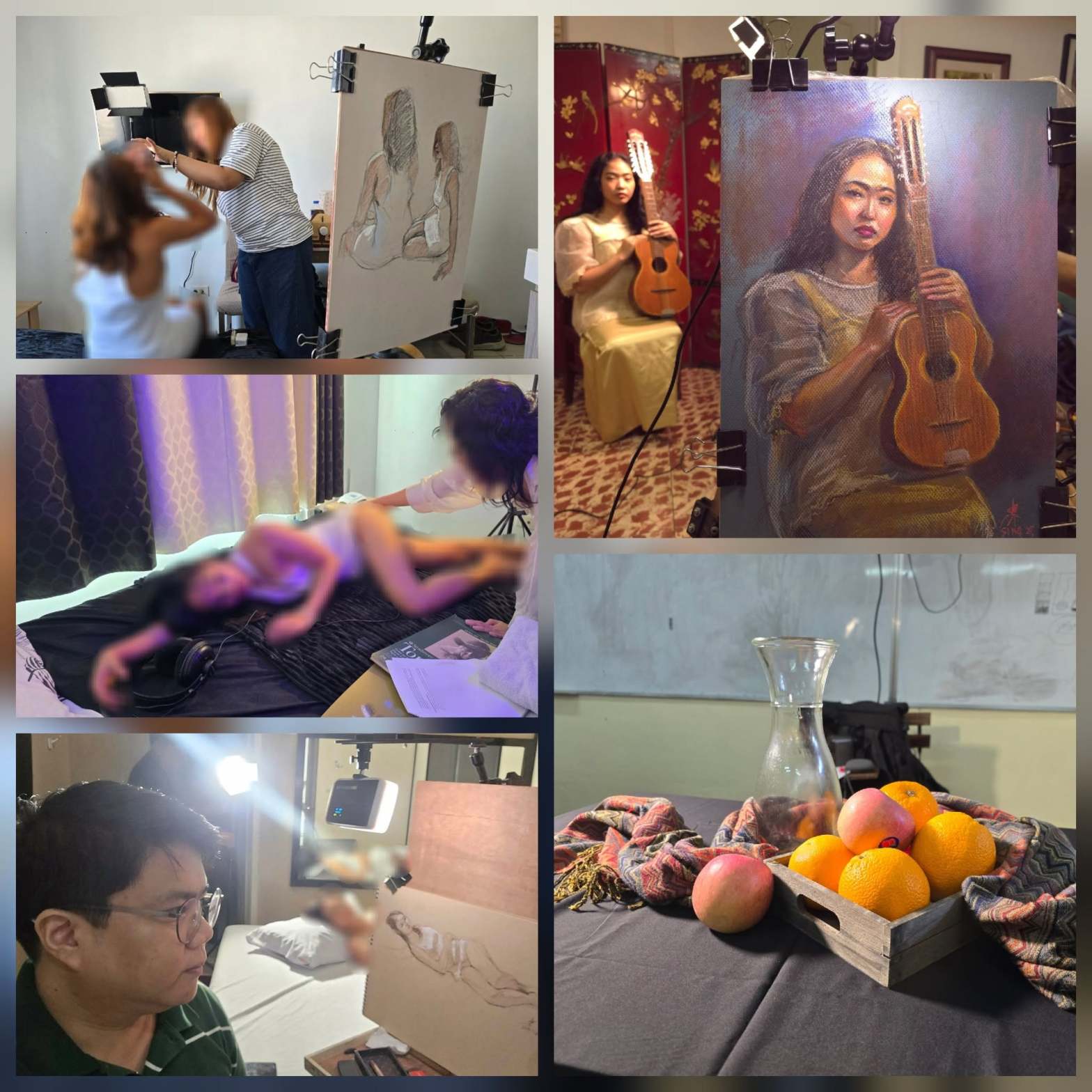
To me, nothing beats the feeling of going through this phase of the creative process – from getting one’s feet wet while painting in a river to appreciating a model’s unique features in a sketching session or shoot. The memories and first-hand learning experiences make the process more meaningful.
Just sharing my thoughts on the use of AI for art:
AI can be used as a tool, but only if the artist already has a solid foundation in terms of skill and creativity. It should not be used as a shortcut to bypass the learning process. The artist also has to provide personal image references and prompts, without violating others’ intellectual property and creative rights. It is a matter of personal integrity on whether an artist will rely more on AI than their own talent and creative juices.
Any generated image must not be passed off as an artwork per se, as it was rendered by a machine, not a human.
The use of certain tools and some practices to speed up the working process has always been a subject of debate in art, e.g., camera lucida / obscura, using projectors, grid vs freehand, tracing, and even hiring workers to assist with the work. To me, it is a matter of personal integrity and preference. Even with ethical and moral considerations, it still depends on one’s choice. Nevertheless, I believe the artist must never be a slave of the tools they use. The tools may not affect the value of the work, as it is largely subjective, even relative to factors external to the artist themself.
I know a globally acclaimed master (recognized by artist societies) who uses AI to improve (e.g., seamlessly combine) their personal reference photos. The work even gets accepted in juried international exhibits hosted by reputable organizations. Contrary to sweeping claims that artists who touch AI are automatically weak or inferior, this proves that the impact of a tool depends entirely on the creator’s foundation. That master excels even more when painting from life; their right to use a digital tool is backed by hard-earned skill, unlike those who use AI as a complete substitute for actual talent.
However, separating the individual skill debate from the bigger picture brings us to a heavier issue: the consequence of using AI – the environmental effects of data centers and the tendency of people to depend on it too much. This alone makes me go against it, especially its image generating features that require more freshwater and energy. Given the reality that it seems impossible to stop humankind from using AI at this point (it is integrated even in basic apps), I’d say the right to use AI has to be earned. Much like a driver’s license – AI access and subscription must require screening to see if the end user did not neglect their actual intelligence before relying on something artificial. Even for the most basic functions. But thinking about how we messed up the planet to this point, I am actually losing hope.
Personally, I prefer working from life. When working from references, I prefer taking my own photos and organizing my own shoots. To me, nothing beats the feeling of going through this phase of the creative process – from getting one’s feet wet while painting in a river to appreciating a model’s unique features in a sketching session or shoot. The memories and first-hand learning experiences make the process more meaningful.

