Today, July 7, 2026, marks my 10th year of being involved with art groups, and I’ve been looking back at the people who helped me reach this point.
My career as an artist did not just materialize out of thin air. It is more than a decade’s worth of hard work. This isn’t a list of names to drop; this is an acknowledgment of my roots. As one who does not have a formal fine arts degree, my mentors and influences are my curriculum.
My earliest influence was my late uncle, Joel Leveriza. We used to call each other “Pare.” He was a naturally gifted and had taken a few lessons under Maestro Fernando Sena alongside Mr. Elmer Borlongan when they were kids. Though he never pursued art professionally, he possessed a quiet brilliance that I got to witness firsthand. He didn’t teach me color theory; he taught me how to draw Voltes V. He gave me tips on my earliest attempts at watercolor and oil pastel for school projects and poster-making contests (e.g., he taught me to use a bit of black, burnt sienna, white, and light blue on the hair of people—it never made much sense to me until many years later). He planted a seed that he would never get to see bloom. Uncle Joel passed away on the afternoon of April 11, 2008—around three hours before my college graduation (he likely died in my arms, on the way to the hospital, I will never forget that).
Between Pare’s early lessons and my eventual leap into the art world, there was a long stretch where art seemed at the backseat, yet my skills got slowly built. I was deeply into anime and Magic: The Gathering, and those fueled my desire to draw in my spare time. For more than three years in high school, I majored in drafting. Under the guidance of my teachers, Ms. Lourdes Dematera and Ms. Olivia Vergara, the plates we were required to do instilled a rigorous work ethic (I never got to finish my scale model project in the final year though, despite the Red Bull Barako overdose). Those plates provided the crucial practice and structural insight that I didn’t realize I would depend on later. When I graduated, I wanted to pursue fine arts, but we just could not afford it. A Japanese anime that premiered locally at Animax (Great Teacher Onizuka) inspired me to become a social studies teacher instead.
In college, I learned more about acrylics because of a Jerry Yarnell book my humanities instructor lent to me. I tried to do manga using speedball (thank you, WOWOW channel for that random Saturday night flick with the cute manga artist). I used soft pastels for coloring, and acrylics when I could afford them. I won two University-wide on-the-spot painting contests.
After that, I spent years standing in front of classrooms teaching social studies, with painting relegated to a minor hobby along with music. I have accepted the idea that painting was not for me and was getting more into guitars and music, but somehow, I never lost touch with the arts—the art app classes I taught; some shows that I watched including some Bob Ross episodes, and a handful of creative projects.
The real turning point hit in 2015 when I won the professional category of the First Mandaluyong Painting Competition. That victory didn’t just give me confidence; it opened doors for me. My deep thanks go to Froilan Galpo, whom I met there and who eventually introduced me to many things including studio portraits, oil painting, and even motivated me to join national competitions.
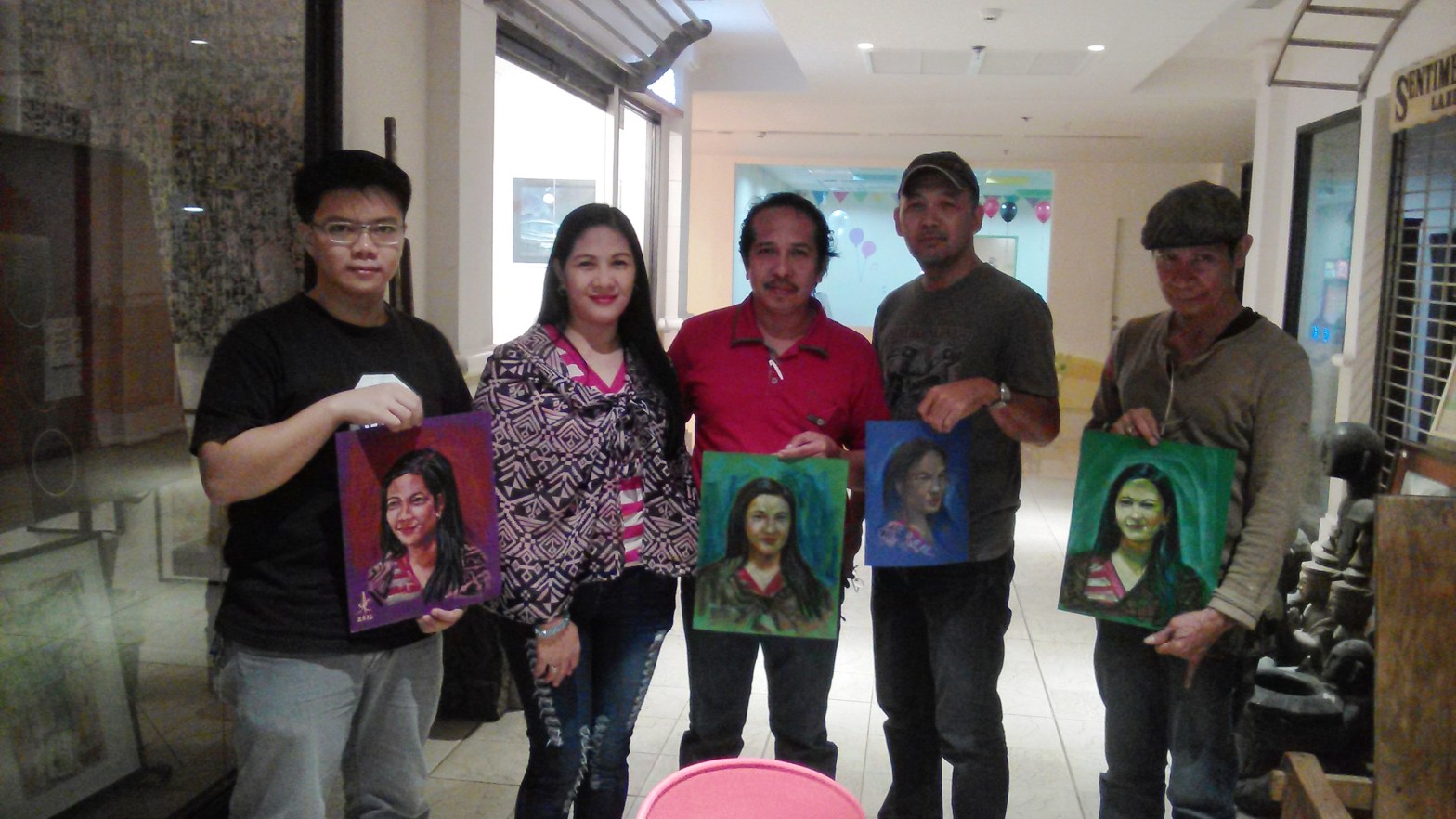
If the competition was the spark, the formation of the 2Q Artists Philippines group ten years ago was where my views on art were dismantled and rebuilt. It happened on a quiet Saturday at Bangerahan Arts and Antiques in Shangri-la Plaza. Up until that point, I didn’t realize how much of a novice I was—especially when it came to professional live portraiture.
That’s where I met a trio of mentors who completely rewired my process. Mr. Jeffrey Consumo (Kuya Jeff) was a revelation. He emphasized speed and unapologetically broke the artistic norms I had held sacred, specifically with his radical use of oil pastel on felt. To help me understand Kuya Jeff’s unorthodox methods, Mr. Abelardo Lovendino (Kuya Abe) stepped in. He became my bridge to impressionism, making those seemingly wild techniques graspable and practical.
And then there was Mr. Moyo Montes—Kuya Moyo, as I call him. If Kuya Jeff and Kuya Abe taught me how to break out of my shell, Kuya Moyo grounded me in the heavy, necessary disciplines of the old masters. He opened my eyes to Joaquín Sorolla, William-Adolphe Bouguereau, and many others. More importantly, he taught me the principles of value, edges, and depth. Many of the things I do today are rooted on his wisdom. Thanks to these mentors, I constantly crave to paint from life.
I knew I had to learn more, and finding the right people to learn from was crucial. In terms of pure foundational knowledge and the sheer volume of workshops, the Philippine Pastel Artists (PPA) had an immense impact on me. It was there that I absorbed essential technical know-how (even cravings for materials, a.k.a budol). I joined the National Pastel Competition twice and received honorable mentions each time.
But if I were to point to the group that had the greatest impact on my progress, it is Grupo Kwadro. Kwadro became my creative home. Being surrounded by the veteran members—whose traditional techniques and mindsets perfectly aligned with my own—gave me the ultimate room to explore. Witnessing the live painting prowess of artists like Sir Carlos Cee Cadid and Sir Nik Masangcay forced me to level up. Kwadro solidified my commitment to painting from life and its strict discipline (e.g., not relying on gadgets during sessions). In every session, I challenge myself to do something different—whether experimenting with backgrounds, sticking to a limited palette, skipping the use of pastel pencils, and so much more.
More learning opportunities came when I joined the Filipino Portrait Artists Guild (FILPAG) and The Outdoor Archivists (TOA). While 2Q, PPA, and Kwadro gave me the foundation, FILPAG provided more portraiture practice opportunities, while TOA kept me inspired to do plein air as it was a dedicated plein air group. The artists in both groups are really nice people, too.
Also in the early 2010s, we had high speed internet connection installed, and I was able to discover living artists I wanted to learn from. Watching James Gurney’s plein air adventures fundamentally changed my process. He is the GOAT in my book. Because of his videos, I built my own custom painting rig and completely fell in love with casein. To this day I am obsessed with the videos of Place du Tertre artists like Davy Lim (who runs his YouTube Channel) and his wife Agnes Fabricius, Svay Teng Denis, and others. The videos of Vicente Romero Redondo, Osamu Obi, and Vladimir Volegov also greatly inspired me.
Today, I am pushing the boundaries of what I know. Every brushstroke is informed by Kuya Moyo’s advice on value and edges, Kuya Jeff’s fearless execution, the field-tested wisdom and discipline of Kwadro, and the knowledge and support from PPA. Every plein air session carries the spirit of Gurney’s rig. Every figurative piece holds a trace of those early activities with Froilan. And at the absolute foundation of it all are the memories of our drafting classes and even Pare.
I want to be good. Really good. I know the chops are important. As one who used to be in a band (I used to handle lead guitar duties and practiced riffs for hours daily thanks to Steve Vai’s “Alien Live Secrets” and Jamie Andreas’ Zen-like methods), I dream of joining my heroes on stage. The same goes for painting. I want to learn as much as I can and improve my chops before I start breaking things (e.g., techniques and tradition). It is also my way of honoring my mentors and their legacy. I teach too; thus, I must never cease to learn.
I didn’t have an art school. I had them. They are the foundations of everything I am today, and I will always be grateful. 

