I first used the medium for a school plate way back in high school, around 2002 or 2003. I recently bought a few sets as the result of watching James Gurney’s YouTube lessons.
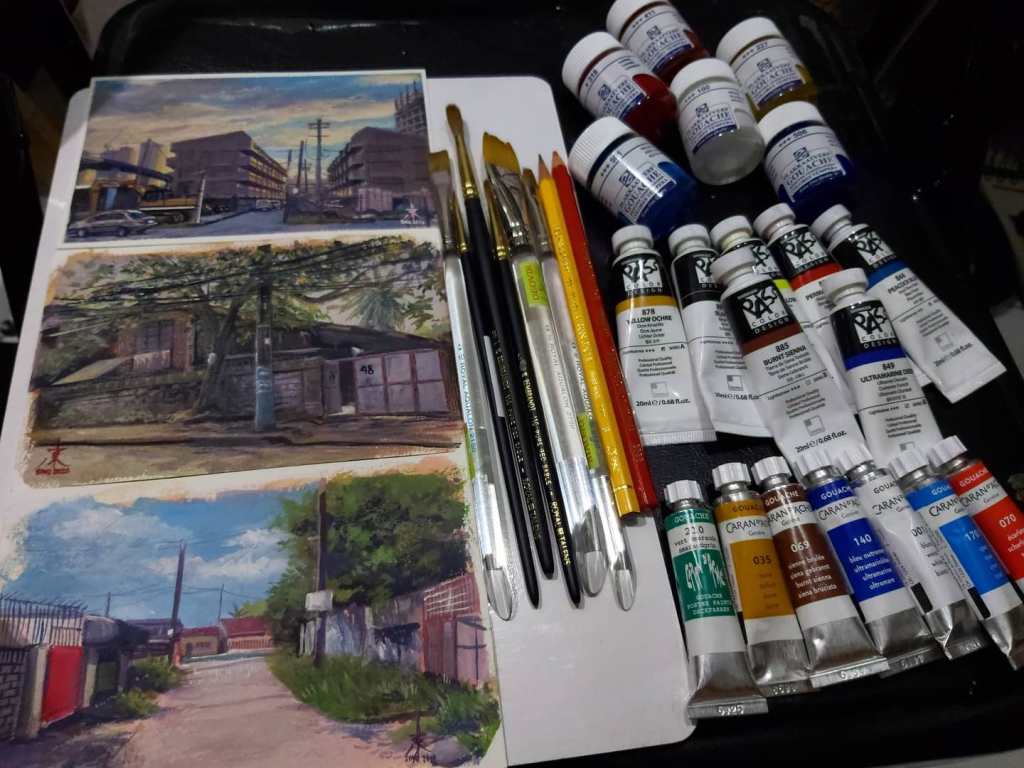
I made three gouache studies on postcard-sized arches watercolor paper. I used Rembrandt pure red sable pointed brushes and Royal & Langnickel Aqualon synthetic flats. For the sketches I used Caran d’Ache technograph and Supracolor 2 pencils (from a sampler box). I used only a limited palette for all studies, with up to eight colors at most. James Gurney always used gouache outdoors and relied on a limited palette; thought thay maybe I should try it too.
I used three different brands of gouache in attempt to study and compare their characteristics. For the first one (bottom to top) I used Caran d’Ache studio, for the second one Shinhan Pass with Royal Talens extra fine white, and for the third one I used Royal Talens Extra Fine.
Of the three brands, Caran d’ache seemed to be very chalky and dried with the least intensity. The other two on the other hand had greater color saturation and covering strength. Shinhan Pass seemed to be the most versatile of the three, with some colors having some slight sheen when dry. All brands also seemed to have good opaqueness and rewetting capabilities.
Gouache seems to be a versatile medium: quick drying, rewettable; ideal for plein air paintings and studies. It can be combined with watercolors too for greater versatility. The matte finish gives gouache artworks a distinct look and makes them a lot easier to photograph.
I first came across soft pastels in 2003, when I was in fourth year high school. I and two other classmates represented our school in an art competition sponsored by 3M in Robinson’s Galleria. We lost. That day, however, became a major turning point in my life.
It was an on-the-spot competition, hence we had to wait for a few hours for the announcement of winners. Our drafting teacher, Ma’am Olive Vergara, allowed us to explore the mall. We came across the stall of an artist working on the portrait of a couple. We were stunned at how realistic his work was. His medium quickly caught my attention. It seemed like fine powder, which he applied with a brush. I could still remember him combining yellow green and orange powder to create skintones, my jaw dropped when he did that. I came from the land of poster paints, oil pastels, and felt tip markers. I have used watercolor and gouache in some of my drafting plates and heard about acrylics and oils, but I have never seen anything like it. His medium was the Holy Grail. Unable to hold back my curiosity, I asked him what it was.
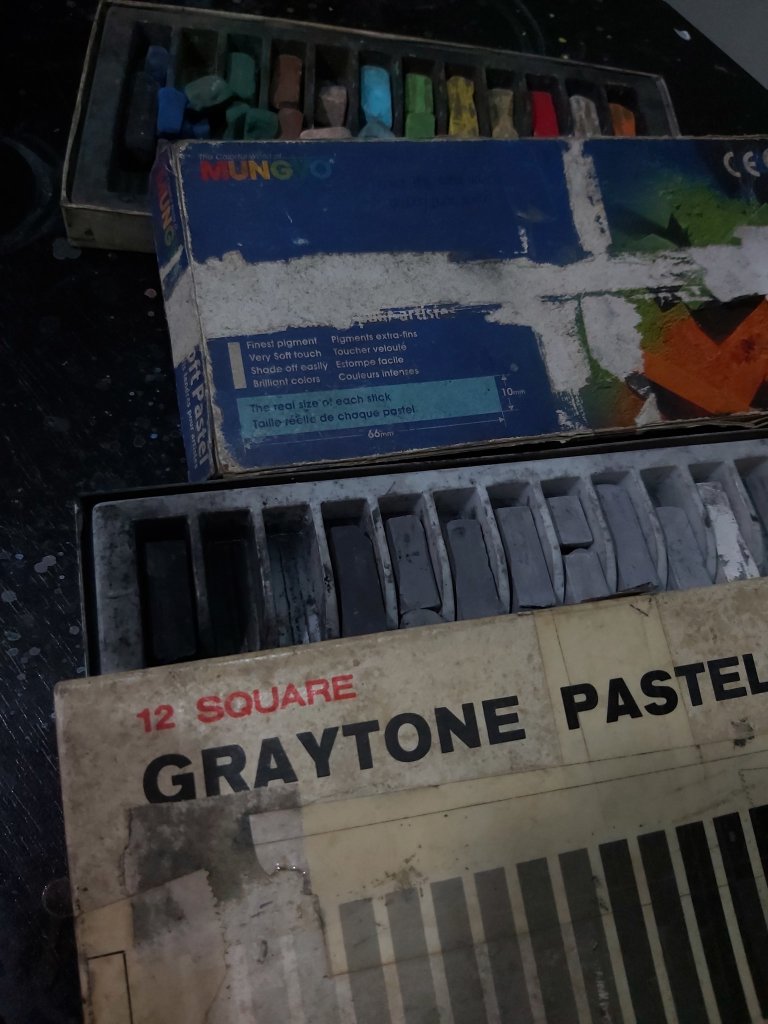
He said that he was using soft pastels. Mungyo, specifically. He showed me a small box of 12 colors. Right then I knew that I needed to get one for myself.
I soon found a box in a National Bookstore branch. The price was way too much for my budget. It was December and we would exchange gifts worth Php 500.00 in our Christmas party. I had an idea.
The next day, during our lunch break, I wrote the pastel’s details and price on the chalkboard. I announced to the entire class that it was the gift that I want and requested whoever got my name in our exchange gift to please buy it; in return I would also grant my assigned classmate’s wish. Eventually someone asked me about the pastels. The plan worked, I thought. I went to Broadway Gems with my mother to buy a birthstone necklace for my other classmate. The necklace was a bit more expensive than the pastels. We did not have much back then, that we could not afford to buy both at the same time.
Then came our Christmas party. My classmate Katrina Uy Impreso really bought the pastels, as I requested. It was sheer bliss. When I got home, I took a couple of brushes and used it to create a portrait of Diana Zubiri on a short folder (too bad it’s gone). It was hard, but the attempt succeeded. I slept at 5:00 AM the next day.
I fell in love with the medium. I used it heavily to color my anime drawings. It was like an extension of my soul that it was in my bag everyday. One time I made a portrait of Brian May (also gone) on a ⅛ size illustration board that I was able to show to sir Joel Tabuena when I bought a custom Valentine mug for my mother from his Likhang Uling shop in Marketplace Kalentong. Sir Joel was very kind, I was there for a little above an hour yet I learned a lot about the medium. A few months later I found a box of gray tone pastels in National Bookstore EDSA Central and bought it for only Php 99.00. I used it with my original box of 12 colors for nearly all my artworks (mostly anime) until I stopped drawing around 2007, before my practice teaching. I was getting more into teaching and music at that time, thanks to GTO and Steve Vai. The last time I used my Mungyo pastels was in 2009, when I tried to make a portrait of Sam Pinto. Yet I always kept them on a safe spot.
About a decade later since I last used them, my Mungyo pastels are still with me. I’ve had them for almost 17 years! I don’t plan to use them anymore, will keep them in my shelf as a reminder of how my love for pastels began. Since I renewed my vow to become an artist in 2015, I have spent a great deal of time and effort to learn about the medium while trying to buy all the pastels that I could afford. I have met a lot of artists online and offline; with some being among the greatest pastelists in our time. With their tips and the majesty of their works, after many hours of practice, and hundreds of pastel sticks later, I was able to create artworks that I never thought that I could actually do. I am always preoccupied with the ardent desire to improve my skills and push my abilities to the limit, to the point that it wakes me up in the wee hours (and instead of practicing I ended up writing this, lol).
I could not help but reflect on how I felt so contented with a small set of 12 colors and a few gray tones back then. I knew that the medium and my small sets had a lot of limitations, yet I felt that I could do everything as long as I had them. After 17 years, my original pastels are still taking me to school.
 Sining ni Sing